Gallery 303
Gallery 303 exhibits Buddhist scriptures from the Dunhuang Sutra Cave and from the South of the Yangtze Delta, showcasing mainly Buddhist sutras in handwritten editions and block printing editions in the Tang (618-907) and Song (960-1279) periods.
Most sutras before the late Tang period were transcribed by hand. The Tang Dynasty handwritten sutras discovered in the Dunhuang Sutra Cave allow us to look into the state of sutra transcription in this period. This exhibit especially showcases the scroll of Early Tang script, written in black ink, The Biography of Huang Shiqiang in Bodhisattva Samantabhadra Speaks the Testimony Sutra. It is the most complete handwritten edition of this sutra in existence today.
With the development of block printing in the Five Dynasties (907-960), block printing edition sutras became the mainstream and handwritten edition sutras began to fade out, making them precious historical commodities. This exhibit showcases two of these precious pieces: the scroll of the late Tang to Five Dynasties (836-960), 17-meters long, Chapter twenty-five of The Buddha's Name Sutra written in black-ink, and the hand transcribed Lotus Sutra in silver ink on dark blue paper. Both are outstanding examples of hand transcribed sutras from Jiangnan, the southern part of the Yangtze Delta. Also featured in this exhibit is the block printing edition of The Precious Chest Seal Dharani Sutra of the Whole Body Relics Concealed in All Buddhas’ Minds in the period of King Qian Chu. The excellent quality of the ink and scroll paper, and the fine printing demonstrated the cutting-edge state of Wuyue block printing technology.
Handwritten Sutras from Dunhuang
Most of the sutras prior to the end of the Tang Dynasty (618-907) were written by hand. Yet extremely few handwritten sutras transcribed before the Tang Dynasty had been discovered in history. It was not until the discovery of Dunhuang Sutra Cave that these thousand years old treasures were uncovered in mass quantity. This gallery showcases four pieces of Tang handwritten sutras from the Dunhuang collection. They are all finely written in black ink and inserted with color paintings.
Sutra Scrolls from Jiangnan, the southern part of the Yangtze Delta
Beside Dunhuang, handwritten sutras were also uncovered in Jiangnan, and most of them were unearthed in the Province of Zhejiang, China. With the development of block printing in the Five Dynasties, block-printed edition sutras became the mainstream and handwritten edition sutras began to fade out, thus making them rare and precious historical commodities. This gallery displays sutra scrolls from Jiangnan, including both handwritten and block-printed editions from the Late Tang to Northern Song periods (836-1127).
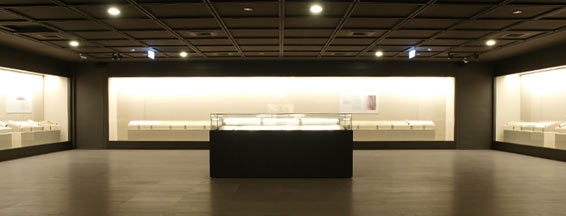
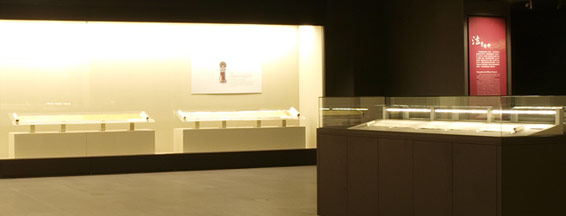
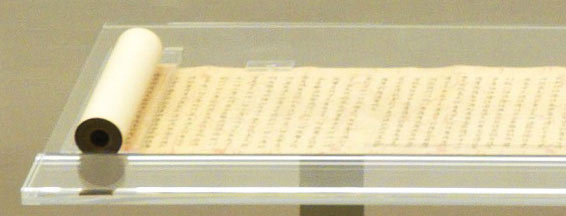
SELECTION
Biography of Huang Shiqiang in Bodhisattva Samantabhadra Speaks the Testimony Sutra
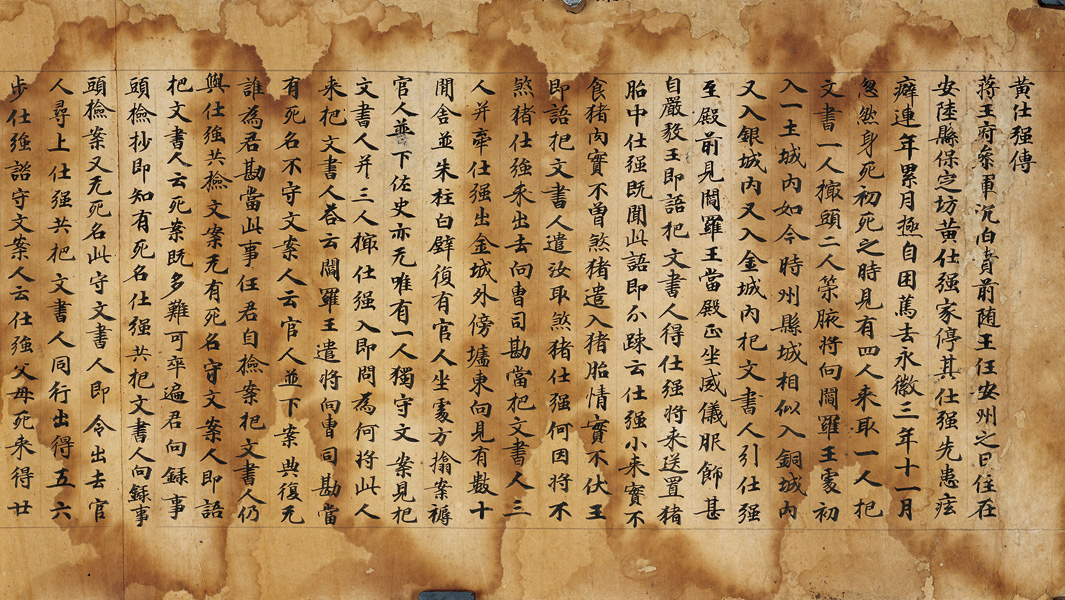
Handwritten in Black Ink. The scroll begins with the “Biography of Huang Shiqiang.” The main text of the scroll is from Bodhisattva Samantabhadra Speaks Testimony Sutra and The Buddha Says the Origin of Incense Fire Sutra Part Two. The last line of the scroll restates the sutra title, “Bodhisattva Samantabhadra Speaks Testimony Sutra.” The scroll is composed of 21 manuscripts pasted together to form one whole piece. A total of 522 lines make up the scroll; each line contains 16 to 18 words.
The scroll is the most complete handwritten edition of this sutra in existence today. The calligraphy was meticulous and exact. It is listed as one of the national cultural properties of China, classified as Class A Heritage. The parable presented in “The Biography of Huang Shiqiang,” which prefaced the text of the sutra, is considered an important piece of writing with high historical and literary value.
Lotus Sutra
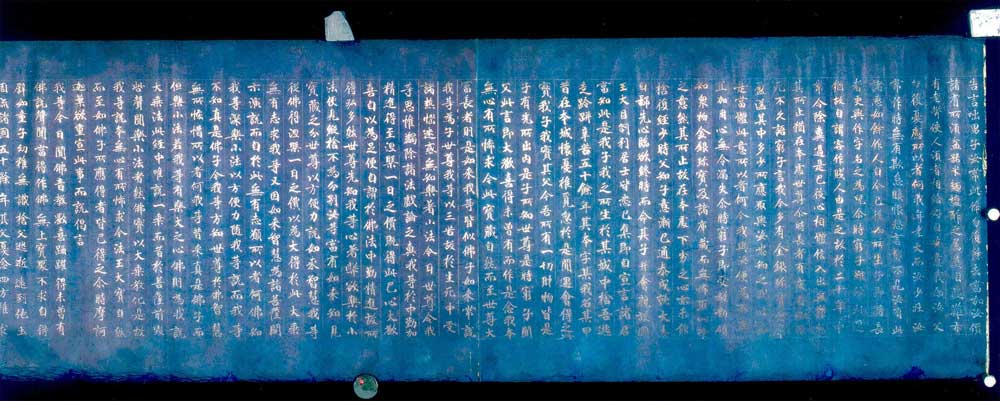
- Northern Song Dynasty (960-1127)
- Handwritten in Silver Ink
- Paper Height: 28.8 cm; Total Scroll Length: 232.5 cm
- Unearthed from the East Tower and West Tower of Eastern Great Temple, Longquan, Wenzhou, Zhejiang, China in 1956
Before the title of the sutra, written in black ink in the style of running-cursive script is: “□□Temple, Monk □□□□.” At the head of the scroll is the sutra title, Lotus Sutra, Volume Two. The body of the script is the text from “Chapter Four: Belief and Understanding,” in the Lotus Sutra. The scroll is made from six manuscripts pasted together. There are a total of 135 lines, and 16-17 words per line.
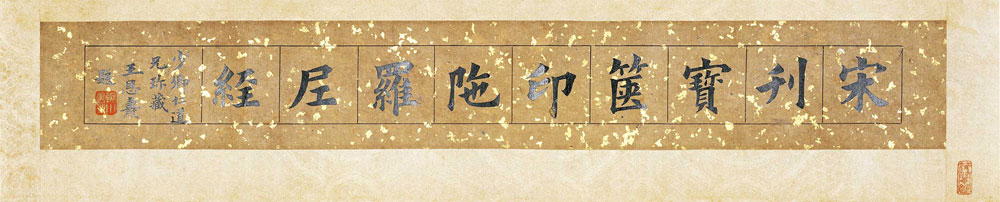
The head of each scroll is printed with the script: “The Great Marshal of all the armies in the whole land, Wuyue King Qian Chu, commissioned Eighty-Four Thousand scrolls of Sutra to be enshrined in West Gate Brick Pagoda with eternal respect/ recorded on the eighth month of Yihai Year (975).” Following this script, there is a painting of worshippers paying respect to the Buddha. Following this painting is the sutra, The Precious Chest Seal Dharani Sutra of the Whole Body Relics Concealed in All Buddhas’ Minds. There are a total of 271 lines, and each full line contains 10 words.
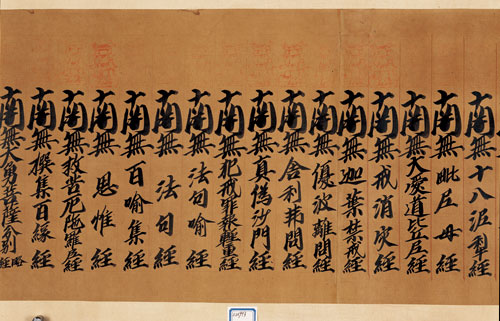
This sutra scroll was handwritten in black ink in the calligraphy style of regular script. The beginning of the scroll is the text of Vows, the end of the scroll is the text of Repentance, and the main body is the text of Chapter Twenty-Five of Buddhas' Names Sutra. At the head of each citation of the Buddha’s name, there is a sealed scarlet image of a sitting Buddha, with a total of 322 Buddha images. Above the title of the sutra, there are 26 sealed scarlet images of pagodas. The whole scroll is composed of 19 manuscripts pasted together. It contains a total of 523 lines. The precursor of block printing was rubbing and stamp production technology. The stamped prints of Buddha and pagodas on this sutra provided a prototype for the future invention of movable type printing in the Northern Song period (960-1279).