Gallery 302
Gallery 302 showcases the cultural artifacts unearthed from the ruins of Leifeng Pagoda and from its cellar, the Underground Palace. The unearthed artifacts from the ruins of Leifeng Pagoda can be classified into three main groups: remnants of the pagoda building structure, stone-carved artifacts, and Buddhist artifacts. Among these artifacts, sutra storage bricks are considered to be the most special and unique items. A small round opening was drilled into either the top or bottom end of some of the bricks that made up the structure of the pagoda, in which a sutra scroll was inserted and hidden. It was in these caches that scrolls of The Precious Chest Seal Dharani Sutra of the Whole Body Relics Concealed in All Buddhas’ Minds laid hidden for ages.
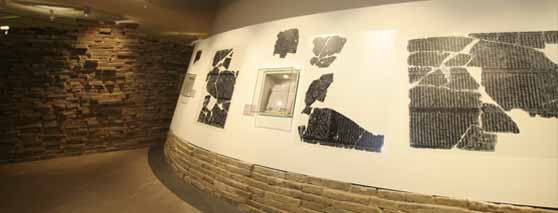
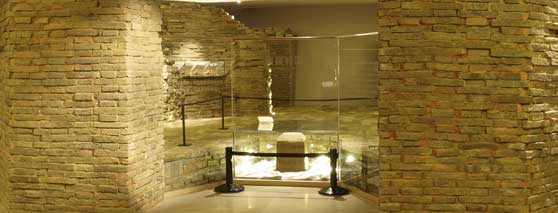
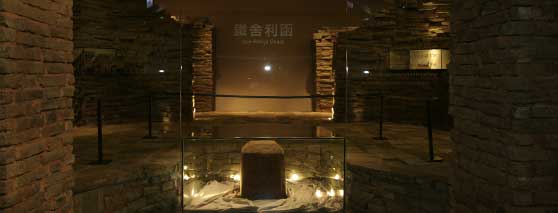
Underground Palace Uncovered
The unearthed artifacts from the Underground Palace of Leifeng Pagoda mainly include gilt silver artifacts, agate ornaments, coins, bronze mirrors, and Buddhist cultural artifacts. They include rare pieces such as the “Gilt Silver Container,” “Gilt Silver Mat,” “Gilt Bronze Statue of Shakyamuni Buddha Preaching the Dharma,” and “Jade Statue of Standing Boy of Good Fortune.” Each of these rare pieces is exquisitely crafted, and definitely should not be missed.
The most anticipated piece showcased in this special exhibit is the famous Iron Relic Chest. It contains some of the most precious artifacts unearthed at the Underground Palace. In particular, Buddha’s hair relics originally enshrined in Leifeng Pagoda was discovered in this very chest, making this indeed a treasure trove of history.
選件說明
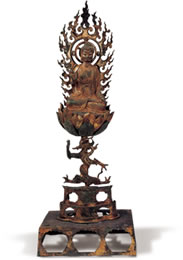
This gilt bronze Buddha statue is made up of five major parts: a mandorla, a lotus pedestal, a dragon pillar, a Sumeru pedestal and a square-shaped base. Each exquisitely designed part was molded separately and then pieced together as one whole unit.
The statue shows the Buddha’ s hair tied in a tall topknot. His right hand shows the Preaching-Dharma mudra. He wears a robe with low-hanging collars over an inner robe with a knotted belt. He sits in a full lotus posture on a pedestal with double layers of upward facing lotus petals. Behind his back stands a mandorla with openwork flame-shaped borders, and a round halo that frames his head.
A soaring dragon lifts up the lotus pedestal where the Buddha is sitting. A flamboyant dragon and a serene Buddha; motion and stillness; stretching outward and looking inward; fury and gentleness, all blend harmoniously in this masterpiece. The harmonious combination of Eastern and Western styles has made this piece a rare discovery in the history of archeology.
Tang Dynasty to Wuyue, Five Dynasties (618-978)
Total Height: 68 cm
Unearthed from the Underground Palace of Leifeng Pagoda, Zhejiang, China in 2001
-
Sutra Storage Brick stamped with the Chinese character “Tian”
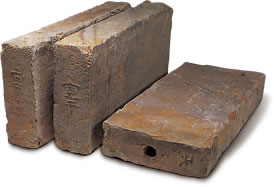
The opening in the sutra storage bricks is for preserving sutras. The diameter of the opening is 2.5 cm, and the depth is 10 cm. These bricks are rarely stamped with any inscriptions. Among the thousands of unearthed sutra storage bricks, this is the only piece found with the character “Tian,” which means “sky” or “heaven,” stamped atop the opening. This is a rare survival piece.
Five Dynasties
Length: 37 cm; Width: 18 cm; Thickness: 6 cm
Unearthed from the ruins of Leifeng Pagoda, Zhejiang, China in 2000
-
Gilt Silver Container Engraved with Chinese Characters “Qianqiu Wansui”
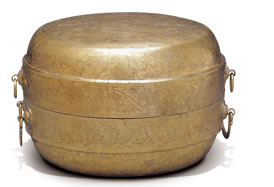
This gilt silver container is made up of a cover and a vessel that interlock. The cover is carved with a pair of flying phoenixes, each holding a blade of grass in its mouth, with wings spread among the intertwining peonies. Four Chinese characters “Qianqiu Wansui,” which means “A Thousand Autumn; Ten Thousand years,” are carved in regular-script calligraphy around the cover. The exquisitely engraved flying phoenixes among flower brocades, blended in with the good wishes of "Qianqiu Wansui," which carries the meaning of longevity and eternity, express the public's longing for prosperity, wealth and blessings. This exquisite piece fully displays the super standard of silverware craft in the Wuyue Kingdom.
Wuyue, Five Dynasties (907-978)
Height: 13.7 cm
Unearthed from the Underground Palace of Leifeng Pagoda, Zhejiang, China in 2001
-
Gilt Silver Mat Engraved with Chinese Characters “Qianqiu Wansui”
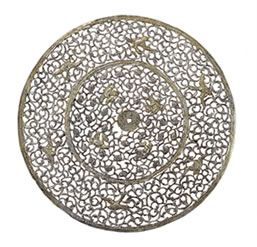
This is a thin round mat with openwork carvings. A ring of bead chain divides the mat into an inner and outer ring. At the center of the inner ring is a round coin with a square opening. Around the square opening is the inscription of four Chinese characters “Qianqiu Wansui,” meaning “A Thousand Autumn, Ten Thousand Years.” Surrounding the inscription are two pairs of mandarin ducks sitting on a pond with intertwining lotus flowers. The outer ring shows six wild geese with their wings spread, flying on top of intertwining honey-suckle plants. The layout of the design is clear, orderly and precise. It gives the impression of a joyous day in spring, harmonious, warm, and fragrant.
Wuyue, Five Dynasties (907-978)
Diameter: 25.4 cm; Thickness: 0.05 cm
Unearthed from the Underground Palace of Leifeng Pagoda, Zhejiang, China in 2001
-
Jade Statue of Standing “Boy of Good Fortune”
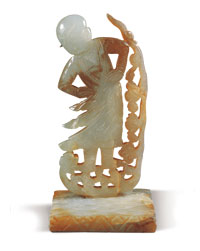
This piece is carved in bluish white jade. There is a tenon at the base of the statue, which is inserted into the square-shaped jade base pedestal. Some portions of the statue are carved in openwork. The back and the front are carved in intaglio with delicate floral motifs. The Boy of Good Fortune wears a robe with cross-over collars, half sleeves, and a belt that ties around the waist. His hands are pressed against the sides of his waists. His robe flows in the wind. His body is bent sideway to the left. Below his feet are floating auspicious clouds. On the surface of the jade base pedestal, low relief engravings and intaglio incisions are both used to depict the cosmic universe of “Nine Mountains and Eight Seas.” Of all the “Boy of Good Fortune” jade statues discovered in China, this piece is the most ancient.
Tang Dynasty to Wuyue, Five Dynasties (618-978)
Total Height: 8.6 cm
Unearthed from the Underground Palace of Leifeng Pagoda,
Hangzhou, Zhejiang in 2001